Okay, let's get serious here. There has been a lot of talk about compact flourescent lights (CFL) lately and how they are going to spare consumers millions, if not billions of dollars in energy use. In fact, their energy savings are supposed to be so great that state governments are even banning the sale of incandescent bulbs to make room for CFLs. In Maine, 100 watt bulbs are off the market beginning in January 2013. Within two years, 60 and 40 watt bulb will be removed. We are all supposed to enjoy the savings of CFLs whether we like it or not. I do not. For so many reasons. One of which is I do not believe the energy savings are there in the first place. Let me explain:
Twelve years ago I bought a Sylvania CFL and put it in a security light outside the barn. It is still there, using a scant eleven watts. The thing is though, it is a Made in USA bulb that cost me nearly twenty dollars. But this was not what the American public wanted: to spend twenty dollars on a bulb no matter the savings. Enter China. You can now pick up CFLs for as little as 75¢. The catch is, the bulbs are cheaply made and they will not last nearly as long as once intended. In my shop I change them out about every eight months. EIGHT MONTHS! So now they need to be disposed, which brings another problem.
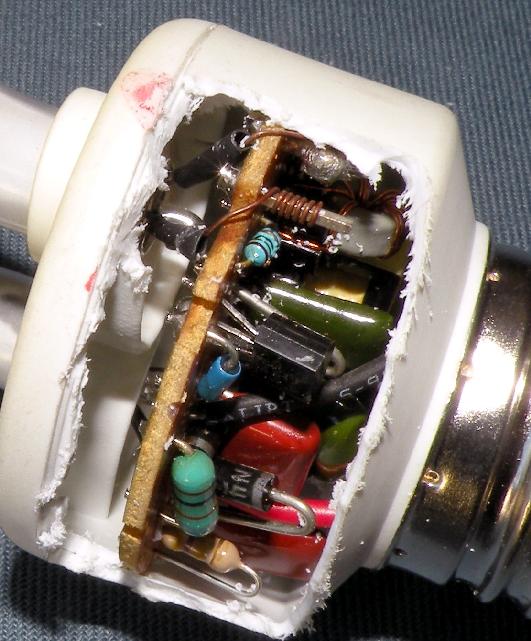
Ever wonder what is inside one of those CFL bulbs that the Maine DEP considers it an enviromental hazzard when one is broken? Take a look at the photogragh. We know the CFL is loaded with nice things like mercury and lead, but what is all that other stuff inside? That can't be good for the environment. All that plastic and
circuitry doesn't just disappear when the bulb is disposed. And how much energy does it require to produce this bulb? Not to mention the packaging needed to transport the bulb safefly all the way from China. Is that factored into the cost savings? Is it more benneficial to the environment than making a standard light bulb?
When I dispose of an incandescent bulb, I can squeeze the thread with a pair of pliers and let the glass fall into the recycler. Then just the thread gets thrown away. I cannot do that with a CFL. We are supposed to carefully carry the used up bulb back to the store from whence it came. Yeah, right. That's what the majority of people are going to do. Not just toss it in a convenient trash can. I don't mean to be cynical here, but I think it is quite naive to think the average person is going to return these bulbs back to the store when they burn out.
As I said earlier, in my shop I find the CFL bulbs last a little less than a year on average. This leaves me with a lot of trips back and forth to the store to return and replace these bulbs. Where is the savings there? Some of the regular light bulbs on display far out live some CFLs.
So what is the answer? My experience is if the lamp is turned on and off throughout the
day, I use incandescent bulbs. If the light will be on 24/7, I use CFL or even LED bulbs. The choice should be yours, but I think over zealous politics is making the decision for you. And I also think some people are making a lot of money selling a product that does not stand up to its claims. In the end, I think CFLs are going to be an environmental nightmare for years to come. I only hope they are the Betamax* of bulbs as new LED technology replaces them.You have to be the judge, but you also have to be a well educated consumer.
UPDATE: January 17, 2013. It has been recently reported through a number of studies that turning a CFL bulb on and off, as we do with many of our lamps in our homes, reduces the life
expectancy of the bulb by up to 85% ! I will get ore information on this and post it here. Please stay tuned.
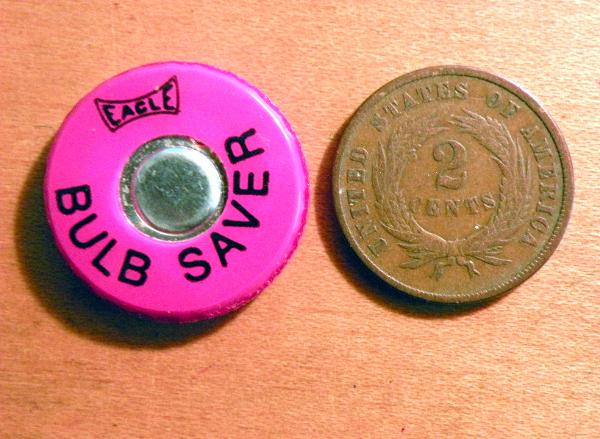
By the way, did you know before the invasion of CFL bulbs there already was an energy saver on the market? Not much bigger than a two cent piece and made in the USA! It works absolutely perfectly, but I guess manufacturers were not making much money on them. Too bad, it didn't take much to produce them, and it certainly didn't take much to ship them.